

Professional services firms that establish strong digital foundations reshape how they grow, with websites carrying weight across the full client journey, from first discovery through to conversion and long-term value.
When you shift from incremental updates to something more deliberate, the results follow. For example, one of our clients tripled their traffic within five months, and another built a consistent pipeline of leads through their site. These reflect what happens when your website becomes a place where brand, experience and performance meet, supporting acquisition, authority and revenue in equal measure.
Our audit gives you a way to assess how your website performs across the areas that matter. Infrastructure. Content. Discovery, both traditional and AI-led. Conversion. Measurement. And the systems that keep improving performance over time.
The shift that reshaped the legal sector.
The pandemic compressed years of change into a matter of months, making digital capability visible in a way it had not been before. Firms saw clearly where their infrastructure supported them and where it held them back. Those that moved with confidence had already treated their website as a core business asset, shaping it around how clients find and engage with them.
Cains offers a clear example of how that plays out in practice. An offshore law firm with over 20 years as a Top Tier firm in The Legal 500 UK, they had the credibility and capability in place, but their digital presence needed to reflect that same level of ambition.
A focused rebuild grounded in user experience and modern design created immediate traction:
- Within five months, website traffic tripled.
- Google impressions increased by over 70%.



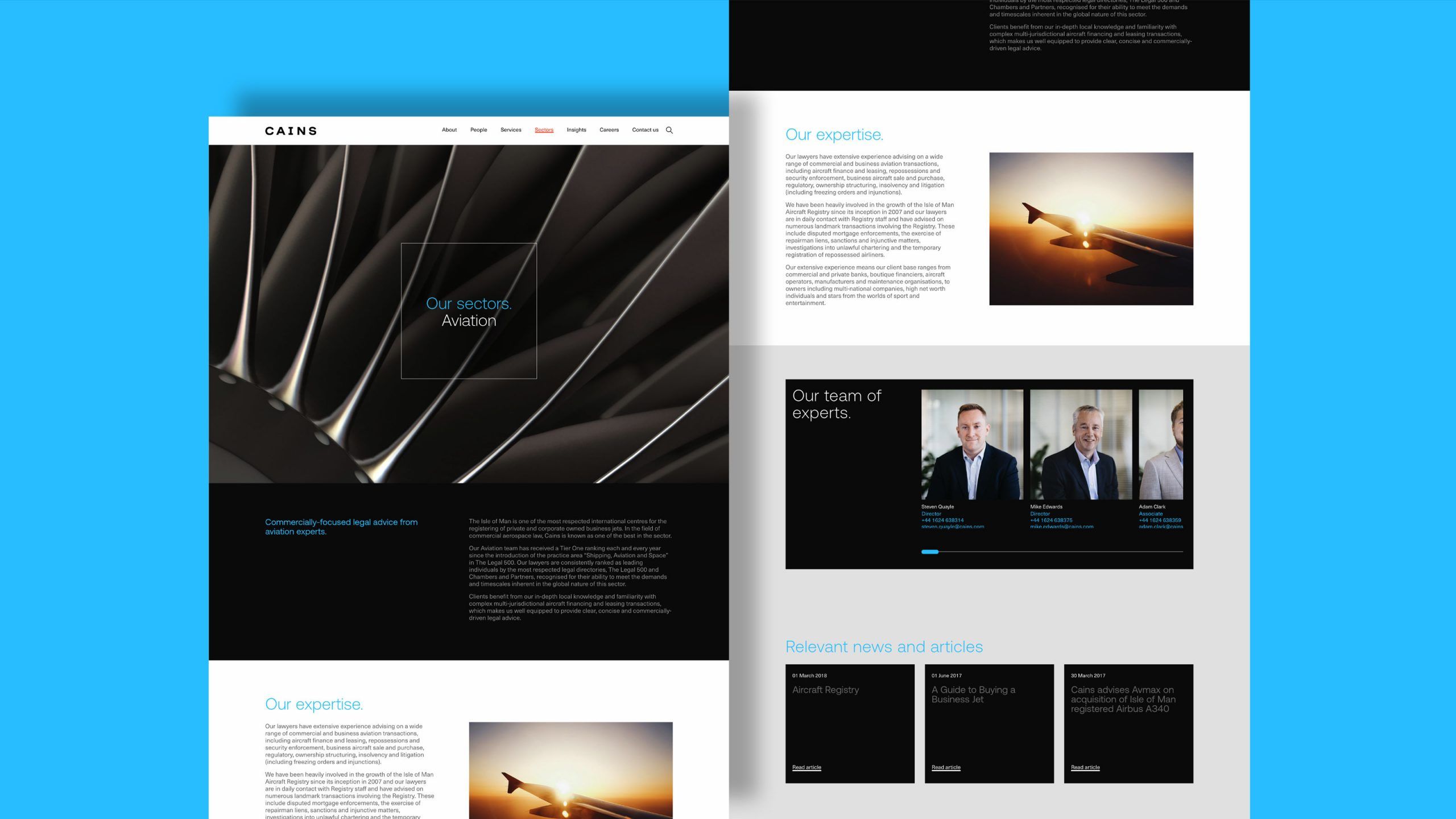
The transformation connected how the firm presents itself with how clients actually search, assess and engage.
Across the sector, similar patterns emerged. Firms that invested in well-optimised websites strengthened their ability to attract clients, operate with resilience and build credibility in increasingly transparent markets. And so, attention gradually moved towards how effectively a digital presence can support growth, which reshaped how we measure performance.
Traffic alone stopped being a meaningful signal. Leading firms began to track metrics tied directly to business outcomes such as:
- Cost per acquisition.
- Lifetime client value.
- Conversion rates across each stage of the pipeline.
- Revenue linked back to digital activity.
This level of visibility creates a more grounded understanding of what works and where to invest next.
What digital transformation looks like in practice.
As measurement matured, so did the definition of transformation itself. It became less about introducing new tools and more about rethinking how those tools support the way you operate – how services are delivered, how clients interact with your firm, and how internal teams work together clearly and efficiently.
The most effective approaches follow a natural progression:
- First, establish the foundations that hold everything together.
- Then build out client-facing capabilities that improve access and experience.
- From there, focus on discovery and conversion, ensuring that visibility leads to meaningful engagement.
Additionally, new technology further supports this process:
- Cloud-based systems now centralise case information and communication, making them accessible wherever teams need them.
- AI-powered research reduces time spent analysing case law from hours to minutes.
- Document automation speeds up routine work.
- Client portals introduce transparency and give users a clearer sense of control.
- Integrated analytics platforms reveal patterns that help you understand performance at both operational and marketing levels.
As these elements come together, your reach extends across multiple channels at once. Organic search continues to lead, supported by paid activity, content, social platforms and increasingly AI-driven discovery. The ability to measure and adjust in real time creates a level of responsiveness that supports steady, sustained growth.
This is why investment in technology has increased across the legal sector between 2021 and 2025, particularly in areas such as generative AI, knowledge management and integrated operational platforms. The firms that see the strongest returns are those that connect these investments directly to their broader strategy. Leadership alignment plays a defining role here. When the direction is clear, the technology supports it.
The metrics that drive momentum.
With that structure in place, performance becomes easier to track and improve, as measurement reveals how prospects move from initial discovery through to engagement and conversion.
Organic search and discovery.
Organic search now accounts for over half of all website visits. It reflects how clients behave. When a legal need arises, search becomes the starting point.
The returns build over time. A strong SEO strategy continues to deliver without requiring constant spend. As discovery continues to expand, traditional search remains central, while AI platforms such as ChatGPT, Perplexity and Google’s AI Overviews play an increasing role. Optimising for both creates a broader, more resilient presence.
Conversion metrics.
Traffic only carries value when it converts. Across the legal sector, median visitor-to-lead conversion sits at 6.3%, with variation from 0.8% to over 21%.
Small improvements here have a clear effect. Even a 0.5% increase can lift client volume without additional spend. Channel choice also influences outcomes. Paid search converts at nearly twice the rate of paid social and three times that of email.
Cost per acquisition.
Cost per acquisition varies widely by channel and practice area. Firms that build strong organic foundations see this cost reduce over time. Budget shifts from short-term spend into channels that compound. Over three years, blended acquisition costs can fall significantly while overall investment stays consistent.
Turning optimisation into a discipline.
Optimisation needs to be embedded into how your business operates. Leading firms approach it with structure, identifying the elements that drive performance and refining them over time.
This shows up clearly in content architecture. Dedicated pages for each practice area consistently outperform broader, consolidated pages. A firm offering divorce, custody, adoption and prenuptial services benefits from treating each area with its own focus, aligning more closely with how prospects search and engage.
Clarity in messaging plays an equally important role. Headlines that speak directly to client needs create stronger engagement than feature-led descriptions. Supporting content builds depth, with case studies, testimonials and clear credentials reinforcing expertise in a way that feels tangible.
The same principle applies to campaign activity. Directing paid traffic to focused landing pages creates a more coherent journey. With fewer distractions and a clear path to conversion, these pages often achieve conversion rates two to three times higher than traffic sent to a homepage.
The website readiness audit. A Strategic Checklist.
For professional services firms seeking to evaluate their digital maturity, this checklist provides a structured framework covering all critical dimensions.
1.Strategic foundation.
Is your website treated as a strategic business asset or a marketing afterthought?
- Executive ownership: Does a senior partner champion digital transformation with budget authority?
- Integration with firm strategy: Is your digital roadmap aligned with 3-5 year business development goals?
- Clear ROI framework: Can you demonstrate revenue attribution and cost per acquisition for digital channels?
- Unified discovery strategy: Do you optimise for traditional search, AI platforms, and direct referrals?
2. Infrastructure & technical foundation.
Does your website platform support your current needs and future growth?
- Modern CMS with active security updates and mobile-responsive design
- Page load speed under 3 seconds (over half of mobile visitors abandon slower sites)
- Analytics integration configured correctly with conversion tracking
- CRM/marketing automation integration for seamless lead capture
- Structured data markup (schema.org) for enhanced discoverability
3. Content strategy & thought leadership.
Does your content demonstrate expertise and drive discovery?
- Dedicated practice area pages
- Benefit-focused messaging addressing specific client scenarios
- Regular thought leadership publishing (nearly half of managing partners rank this top-three)
- Comprehensive coverage addressing nuanced questions prospects actually ask
- Clear author attribution with credentials and professional authority signals
- Case study integration with specific client outcomes
4. Discovery optimisation. SEO & beyond.
Can your ideal clients find you when they search?
- Research-backed keyword targeting (practice area + location combinations)
- On-page optimisation (title tags, meta descriptions, header hierarchy, internal linking)
- Local SEO (Google Business Profile optimised, review management)
- Technical SEO (XML sitemap, structured data configured)
- Link building strategy (earning backlinks from authoritative sources)
- Content freshness and regular updates
- Earned media presence (bylines, industry coverage, professional recognition)
- Authentic community engagement (answering questions, contributing expertise)
5. User experience & conversion.
Does your website make it effortless for prospects to engage?
- Clear navigation accessible within 2-3 clicks
- Multiple conversion paths visible on every page
- Trust signals prominently displayed (testimonials, case results, awards)
- Minimal form friction (no CAPTCHA barriers)
- Campaign-specific landing pages (not just homepage)
- Video content demonstrating attorney expertise
6. Performance measurement & analytics.
Do you have visibility into what's working?
- KPI dashboard with real-time visibility into traffic, leads, consultations, retained clients
- Conversion funnel tracking at each stage
- Channel attribution (understanding which marketing channels drive highest-value clients)
- Cost per acquisition monitoring by practice area, channel, campaign
- Regular reporting cadence (weekly operational, monthly strategic reviews)
7. Client intake & conversion infrastructure
Do you capitalise on leads generated?
- Lead response time within 5 minutes (speed-to-lead benchmark for high conversion)
- CRM integration with automatic lead capture and assignment
- Online consultation booking tools enabling self-service scheduling
- Streamlined intake process (digital signatures, client portals)
- Lead nurture campaigns for prospects not ready to engage immediately
- Systematic approach to converting leads to consultations to retained clients
8. Continuous optimisation
Are you systematically improving over time?
- A/B testing programme (headlines, CTAs, form fields, page layouts)
- Conversion rate optimisation with iterative improvements
- User testing (gathering feedback from actual prospects)
- Technical performance monitoring (regular audits)
- Content performance review (analysing which topics drive engagement)
- Quarterly strategic reviews (evaluating channel performance, budget allocation)
Case in point: Lewis Silkin.
Lewis Silkin had built a reputation around insight-rich content, read by thousands across legal and client audiences. Their thinking led the conversation. Their website, however, didn’t carry that same energy. It remained static, fragmented and shaped by familiar law firm conventions.
The opportunity sat in that gap – to reshape how the firm shows up digitally. To create a platform that reflects how they think, how they publish and how they engage with their audience.
We started with brand architecture, bringing together a network of sub-brands and affiliated sites into one unified masterbrand. What had previously lived across multiple microsites and locations now sits within a single, modular Sitecore 10 estate. One system. One structure.
From there, we reworked the information architecture to support purposeful journeys, introducing predictive search that responds instantly to user intent. Campaign hubs give content a clearer role in lead generation, while region toggles allow the experience to flex seamlessly across the UK, Ireland and Hong Kong.
The shift in thinking extended beyond structure into behaviour. We drew from media platforms and editorial models, shaping a site that publishes with pace and clarity. Content moves more freely. Navigation feels more intuitive. The experience adapts to different audiences without losing consistency.
Underpinning all of this sits a modular design system built on Sitecore SXA. It brings flexibility at component level, allowing teams to evolve content and campaigns without compromising the overall framework. Sub-brands retain their distinctiveness, while operating within a unified system that strengthens both brand clarity and search performance.
Lewis Silkin now operates with a digital presence that matches the strength of its thinking. One platform. Fully aligned. Built to support growth.
The path forward.
The opportunity is clear. Your website can operate as a connected system that supports how your firm grows, or it can sit adjacent to it. The difference comes down to clarity of intent and consistency in execution.
Firms moving forward with confidence focus on alignment. Strategy, structure and experience working together to support discovery, engagement and conversion. They measure what matters, refine what works and build momentum over time.
This is where we come in.
Let’s get things Done & Dusted.
We are a brand design agency working with professional services firms to turn their websites into active business development engines.
We approach websites as systems that support growth. Strategy, UX, brand, technical performance and optimisation working together. No fluff. Real results.
If you’re preparing for growth, navigating change or looking to strengthen your digital presence, we bring the clarity and execution to make it happen.
Contact us now. Ready when you are.